Thursday, June 7, 2012

Wee Wild Cats

Okay, maybe not wee, but definitely not the size of a lion.  There are a myriad of small sized wild felines out there not nearly as well known as their larger cousins.  Like the kodkod, a cat only found in Chile and a few adjoining areas of Argentina.  It has the spots of a leopard and the striped tail of the tiger.

Source:  Wikipedia

They live in the temperate rainforest and their main prey are birds, lizards and rodents.  With their small range they are a vulnerable species because of habitat loss due to logging.

The Bay cat is a slightly larger endangered cat only found in Borneo.  Also a forest dweller, this elusive cat is thought to be mainly nocturnal, but there have been so few sightings not much is known about it or how many there really are.

Source:  Wikipedia

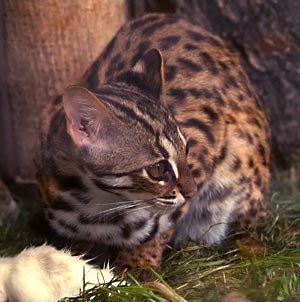
Then there is the leopard cat - not the same thing as a leopard as you will see!

Source:  Wikipedia

Only found in Asia there are 12 subspecies which differ greatly in looks.  This is also a leopard cat, also known as the Amur cat, found in Siberia, Manchuria and Korea.

Source:  Wikipedia

Leopard cats are solitary, and as could be expected the major part of their diet are rats and mice, with a few birds and lizards thrown in for good measure.

Geoffroy's cat is another South American cat that even though it is only about the same size as our domesticated cats, it is at the top of the food chain in many areas of its distribution.

Source:  Wikipedia

Its usual fare are rodents, hare, lizards, frogs and fish.

The two cats that vie for the 'smallest wild cat in the world' title are the Rusty-spotted cat found in India and Sri Lanka...

Source:  Wikipedia

and the black-footed cat of southern Africa.

Source:  Wikipedia

Click here and here for a couple of videos about these beautiful cats.

Monday, June 4, 2012

Possum Predicament

Sunday morning I was out in the back yard hanging up a towel to dry and stopped to pull a few weeds.  When I got about half way back to the door I saw a possum make a mad dash for one of the holes under my big shed.  Evidently it had come out to get a snack of cat food and I surprised it.  As I came around the corner of the small shed, I heard something squawking like crazy, and there was a baby possum who had not taken off when his mom did and had gotten separated from her.  Stray cat Romeo had an alarmed look on his face.  Even though the little possum wasn't a whole lot bigger than a mouse, he knew it definitely wasn't one.  The baby came right over to me yelling, 'help me, help me, help me find my mom!'.  I wasn't sure whether it would let me pick it up, but decided to try.  No problem!  It fit right in the palm of my hand.  I walked it over to the hole under the shed where I had seen mom go.  I put it down next to the hole and took a few steps back; it started to follow me!  So I picked it up again and practically put it in the hole.  It went in this time and momma must have been right there, because although it had been squawking this entire time, there was suddenly quiet.  I'm pretty sure mom and baby were reunited.

What I did was probably all wrong - most likely I should have just gone inside and let momma come out and get her baby.  But with the stray cats in the yard I wasn't sure they would all react like Romeo and didn't want them to get it.  Plus I was sure momma was just as stressed out as the baby hearing its cries and didn't know how long it would take her to get her nerve up to rescue it.  It was simply the fastest way to reunite the pair and keep the baby safe.  I'm glad everything turned out the way it did.

Baby possums are so much cuter than their parents.  I figure the baby was a few months old - when they are born they are no bigger than a jellybean!  And if the possum has moved in under the shed, that explained why I haven't seen the woodchuck lately.  Must have gotten evicted!

Photo by Fiona Sunquist   Source:  Wild Florida

Click here for some great videos of orphaned baby possums - thank goodness mine didn't end up that way!  In #8 you will hear the sound of the baby calling for its mom, which is what I heard.  And #11 tells you all about baby possums.  They are all worth a view.

Thursday, May 31, 2012

Silly Shenanigans 7

Decided it was time for yet another Silly Shenanigans post from my favorite LOL Cats and Dogs website.  Enjoy!


Have a great day!

Monday, May 28, 2012

Cattail Swamp

On my way to work I pass a couple little areas I call cattail swamp.  Of course, it's not really a swamp, but there are cattails - perfect habitat for red-winged blackbirds.  And I have seen them there several times.  Naturally when I stopped to take a few pictures there weren't any.  But I did hear a gluging noise several times - frogs definitely like this little area too.  I've also seen ducks enjoying a dip.  An interesting little mini-ecosystem.


Only the male red-winged blackbird actually has red on his wings, and the 'epaulet' on his shoulder includes a small stripe of yellow.

Source:  Wikipedia

As with so many bird species, the female gets short-changed when it comes to the color department.

Source:  Wikipedia

Red-winged blackbirds' main diet is seeds, but also eats fruit, insects and even frogs and snails. (The frog I heard better keep an eye out!)  They live in North and Central America, wintering in the southern U.S. and Central America.  Click here to hear their song.

To my complete surprise, I spotted a red-winged blackbird eating the suet I have on my patio one spring a few years ago, but haven't seen any since.  They would certainly be welcome should they decide to make a return visit.

Thursday, May 24, 2012

Cagey Coyotes

I really enjoy my drive to work because I never know what I'm going to see.  I've encountered hawks, herons, Canadian geese, and wild turkeys on my commute through mainly residential neighborhoods.  Wednesday morning I had yet another surprise - a coyote sighting.  It was right before I turn onto a major highway.  I saw a coyote by the side of the road and it had just picked up something in its mouth.  Don't know if it was a mouse or rodent it had chased and killed or whether it was something in the road that was already dead.  But I got a clear view of it right before it turned around and went back into the trees.

Coyotes along with raccoons are one of the most adaptable species when it comes to surviving well in urban areas.  As wolves are driven out by human populations, the coyotes move in.  Researchers estimate that there are up to 2,000 coyotes living in the greater Chicago area and have determined that 'city' coyotes actually live longer than their wilder counterparts probably because their natural enemies aren't around!  More diurnal in less populated areas, urban coyotes are mostly nocturnal.  While small mammals such as mice, rabbits, squirrels, prairie dogs and birds are their natural prey, urban coyotes add cats and small dogs to the menu.  Even in more remote areas, fruit and vegetables are also part of their diet.  Coyotes will also eat carrion, but prefer fresh meat - who wouldn't!  Coyotes will also hunt sheep, goats, and cattle, if available. Coyote packs can also bring down larger prey such as deer and pack hunting is usually more prevalent in winter when other food is scarcer.  When hunting smaller prey, coyotes hunt alone.

Photo by Rebecca Richardson  Source:  Wikipedia

Coyotes have also been known to hunt cooperatively with badgers.  Badgers are good at digging burrows and getting at prey that is underground, while the coyote can run down faster prey that the badger isn't able to catch.  With this tag team hunting style, prey has little chance of escaping.

While it takes wolves two years to become fully grown, coyotes are adults and sexually mature in just one.  There is usually only one lactating female in a wolf pack, coyotes are a little more tolerant.  The average coyote litter size is six, but can be up to nineteen!

Source:  Wikipedia

Coyotes are very vocal and their communication consists of howls, yips, barks, whines and growls.  A long howl lets other members of the pack know where it is, short barks warn of danger.

Known as a 'trickster' in Native American lore, they are often featured in stories because of their cleverness.  Indeed, they are very good observational learners and their adaptability has increased their range from open prairies and deserts to every state in the union, as well as Canada and Central America.

 Photo by Michael S. Quinton  Source:  National Geographic

For a  video clip, click here.

Even though coyotes are becoming a 'pest' species, seeing one is still a thrill.  I wish I'd had a little bit longer look.

Monday, May 21, 2012

A Two Critter Night

Saturday I was at the kitchen sink looking out the window at my neighbor's back porch and saw what I thought was a cat at the food dish.  They keep cat food out for their cat Tigger.  I thought it was the stray cat we call Tabby, but it looked a little bigger.  Then the 'cat' lifted its head. I grabbed my camera and eased myself out the door.


The first raccoon pictures of the season!  I knew the raccoons were around because of reports from the neighbors, plus every morning the outside water dish would be really dirty (explanation below).  But this was the first time this year I'd actually seen one.


As you can see by the long evening shadows, it was about 7:30 and right before dusk.  At first she wasn't too sure about coming over to my house, but I stayed as still as I could and she decided everything was okay.  I don't deliberately feed the raccoons, but at this time of evening there was still a little cat food left on MY patio as well.  She kept her eyes on me as she ate, but then got more comfortable with my presence as time went on.  The stray cats were still around and the cats and raccoons get along just fine.  Then the raccoon decided I wasn't going to bother her and she got downright silly, lying down and playing with the water dish dangling her paws in the water.  Raccoons find their food with their paws.  The more moist the pads on their feet the softer they are, the softer they are the more sensitive they are, so feeling for their food is easier.  Raccoons don't actually wash their food, they wash their paws.


Then I noticed out of the corner of my eye that the woodchuck had come around the corner of the front yard.


The woodchuck finally saw me and ran around my neighbor's house.  But then he came back, walking right by the raccoon and the cat.  Well, actually he checked the cat out first.


In the meantime, the raccoon decided she had had enough water and food and as usual headed for my tree, her favorite after dinner spot, to wait until dark.


A very nice visit indeed.

UPDATE:  Another visit Wednesday night even earlier - around 6:00.  Just had to include THIS photo of kitty Van Gogh in the chair and the raccoon under it.

Thursday, May 17, 2012

Hmmmmm

The last two times I've had the oil changed in my car, there has been a little pile of foam pieces on top of my engine.  The first time I saw it I thought it was weird, but wasn't too concerned.  A fluke?  I had my oil changed a week or so ago and there it was again.  Somebody had built a cozy little nest.  They supposedly cleaned all the nest building material up.  Tonight when I looked there was one piece of foam and a few sunflower seed shells.  I don't recall seeing the sunflower seeds when my oil was changed.


Then I noticed that there were a few holes in the lining of the hood of the car - the source of the foam no doubt.


So who is responsible for this enterprise?

I can't believe it's a mouse with all the cats at my house - both inside and out.  My friends in NJ had a packrat build a nest in their car and chewed through a belt that had to be replaced at their cabin out in Colorado.  AND got in their cabin.  It did quite a bit of damage and it was not a happy ending.  Most packrats do live in the Western U.S. and there are a few species here in the east, but they live in a forest environment.  My friends would probably think it serves me right if I had my own packrat since I kept commenting about how cute they are!

One species of packrat, bushy tailed woodrat  Source:  Wikipedia

A squirrel?  Who knows.  'Tis a puzzlement!  If you have any ideas, let me know.